
The best free online course to learn copyright law in 2026 is the DMCA Takedowns: How They Work and How to Respond course on Brainmunk. It’s structured, requires no account, and covers the full DMCA framework in 7 focused lessons.
If you want a deeper legal foundation, the University of Pennsylvania’s Copyright Law course on Coursera is the best free academic option available.
Most people running websites, creating content, or selling online courses don’t understand their rights until something goes wrong. These courses change that.
Every course below is genuinely free to learn from. Not a free trial. Not a teaser module.
Quick Comparison
| Course | Best For | Length | Certificate |
|---|---|---|---|
| Brainmunk (AI-generated) | Self-directed learners | ~21 min | No |
| Alison — IP Law: Copyright Essentials | Beginners wanting a structured intro | 1-2 hrs | Paid option |
| Coursera — Copyright Law (UPenn) | Those wanting university-level depth | ~17 hrs | Paid option |
| Udemy — Copyright and the Copyright Law | Creators wanting practical DMCA coverage | Self-paced | No |
1. DMCA Takedowns: How They Work and How to Respond – Brainmunk
Best for: Website owners and content creators who need to understand the DMCA fast
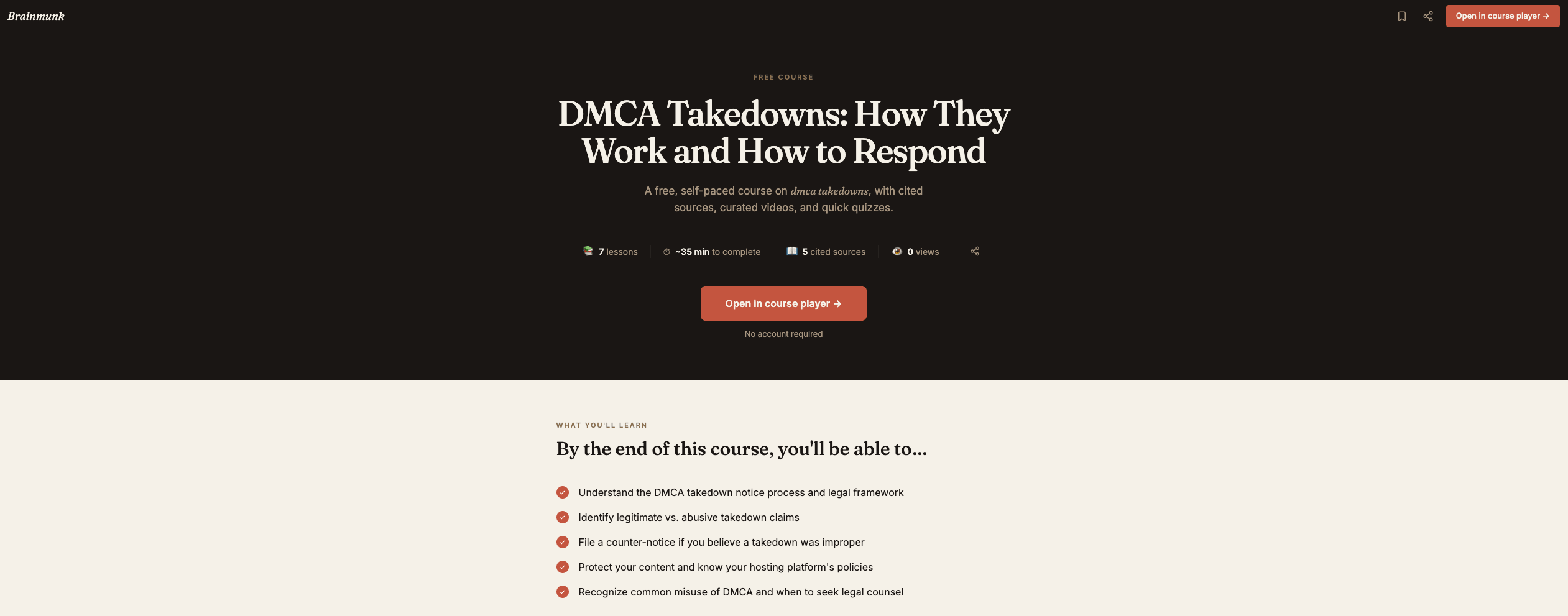
This is the fastest way to understand exactly how the DMCA works, whether you’ve received a takedown notice, need to file one, or just want to protect your content before anything goes wrong.
The course was built using Brainmunk’s AI course generator, which searches the web, structures the content, and produces a research-backed course with cited sources and embedded videos.
The result is a clean 7-lesson course covering the full DMCA framework: what the law is, how takedown notices work, when they’re legitimate, how to file a counter-notice, and when to seek legal counsel.
No account required to access it.
What the course covers:
- The DMCA takedown framework: what it is and why it exists
- Anatomy of a DMCA takedown notice
- When a takedown is legitimate vs. abusive
- Filing a counter-notice and restoring your content
- Platform policies and repeat infringer termination
- Protecting your own content and responding to bad-faith claims
- When to seek legal counsel and litigation basics
Each lesson takes around 3 minutes to read through. You can complete the whole course in one sitting.
Brainmunk is an AI course generator, not a fixed library. If you want to go deeper on a specific topic, say DMCA safe harbor provisions or filing a takedown on YouTube, you can generate a new course on that exact topic in under a minute.
The free plan covers your first three courses with no signup required.
Access the Brainmunk DMCA course free
Pros
- No account or signup required
- 7 focused lessons, completable in one sitting
- Cited sources in every lesson
- Can generate follow-up courses on any DMCA topic for free
Cons
- No certificate
- AI-generated content, not written by an attorney
- Free plan limited to 3 courses
2. IP Law: Copyright Essentials – Alison
Best for: Beginners who want a structured intro to copyright law and IP protection
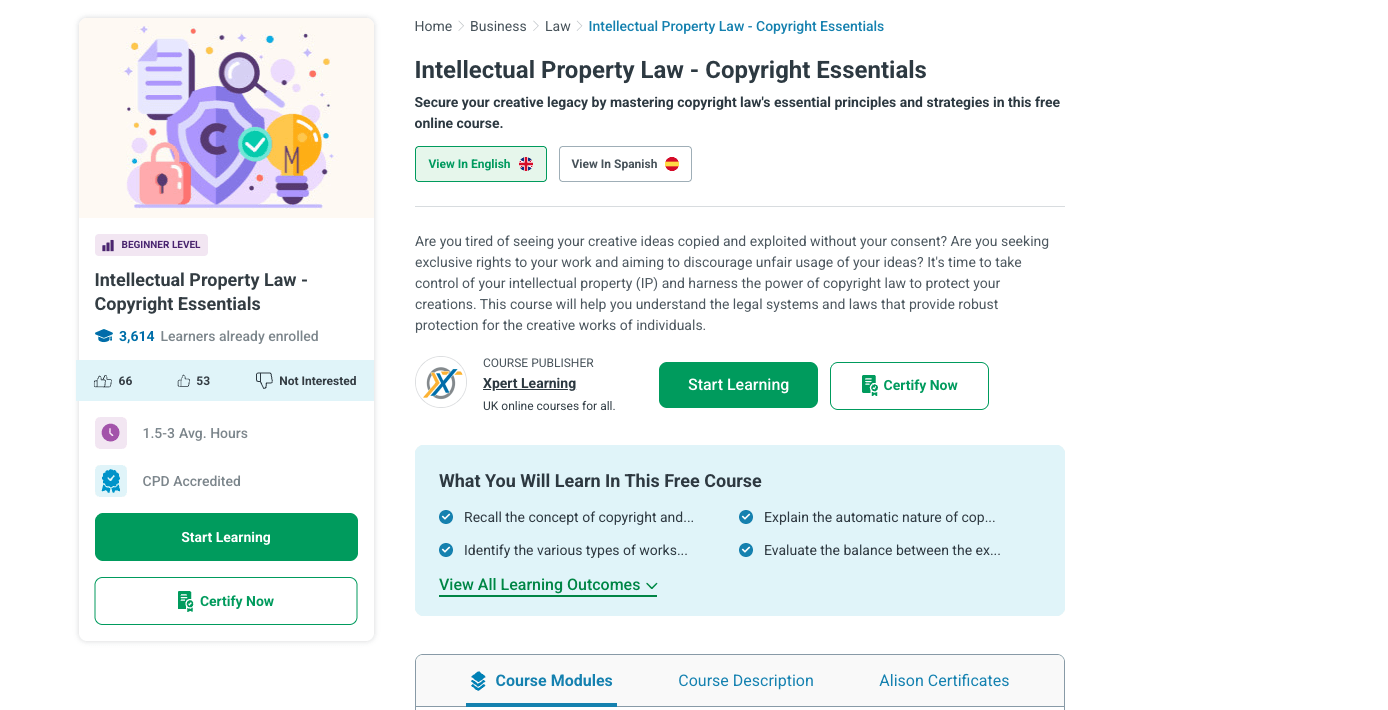
Alison’s free Copyright Essentials course covers the legal systems and laws that protect creative works, starting from the basics of what intellectual property is and moving through copyright fundamentals, infringement, and protection strategies.
It’s a good fit for content creators, bloggers, online course creators, and small business owners who want to understand their rights without a law degree.
All Alison courses are free to enroll in and learn from. A paid certificate is available if you need proof of completion.
Access IP Law: Copyright Essentials on Alison free
Pros
- Completely free to learn
- Beginner-friendly, no legal background required
- Covers infringement, protection strategies, and IP fundamentals
- Optional paid certificate available
Cons
- Certificate requires payment
- Lighter on DMCA-specific content
- US-focused, though broadly applicable
3. Copyright Law – University of Pennsylvania (Coursera)
Best for: Those who want the deepest free understanding of copyright law available online
This course from the University of Pennsylvania is the most academically rigorous free copyright law course available. It’s designed for creative professionals who want to understand exactly what can and can’t be protected under US copyright law.
It covers the system’s basic principles, rules, and institutions, with real case analysis throughout. It goes considerably deeper than the other courses on this list.
The course is free to audit on Coursera, meaning you get full access to all video content and materials at no cost. A shareable certificate is available if you pay for Coursera Plus.
Audit Copyright Law on Coursera free
Pros
- University of Pennsylvania faculty, highest credibility on this list
- Covers real case law, not just summaries
- Free to audit with full content access
- Designed for creative professionals
Cons
- ~17 hours, the longest course on this list by far
- Certificate requires Coursera Plus or paid upgrade
- More academic than practical for day-to-day DMCA use
4. Copyright and the Copyright Law – Udemy
Best for: Creators who want practical coverage of DMCA, fair use, and infringement
This free Udemy course provides a practical understanding of copyright law for creators, entrepreneurs, and business owners.
It covers the rules most relevant to online content: DMCA takedowns, fair use, public domain, copyright infringement searches, and how to protect your own work. It also covers common scenarios like using images, videos, and written content online without triggering infringement claims.
Free to enroll. No certificate.
Access the Copyright Law course on Udemy free
Pros
- Covers DMCA, fair use, and infringement in practical terms
- Relevant to online creators and business owners
- Free to enroll
Cons
- No certificate
- Requires a free Udemy account
- Not taught by an attorney
Which Course Should You Start With?
If you need to understand the DMCA specifically, whether you’ve received a takedown notice or want to file one, start with Brainmunk. 7 lessons, no signup, done in under 25 minutes.
If you want a broader introduction to copyright law and IP protection as a content creator or business owner, Alison’s Copyright Essentials is the most accessible starting point.
If you want to understand copyright at a genuinely deep level and don’t mind investing the time, the University of Pennsylvania course on Coursera is the most thorough free resource available anywhere online.
If you’re a creator who just wants practical answers about what you can and can’t do with content online, the free Udemy course covers the real-world scenarios most relevant to you.
If you’ve received a takedown notice and need help responding, see our guide on how to respond to a DMCA counter-notice.
If you want to file a takedown against someone using your content without permission, DMCA Authority handles that for you.
And if your online course has been stolen, our guides on protecting your online course from piracy and what to do when your course is stolen are the right next steps.
Frequently Asked Questions
What is the DMCA?
The Digital Millennium Copyright Act is a US law that governs how copyright infringement is handled online. It creates a notice-and-takedown system that allows copyright holders to request the removal of infringing content from websites and platforms.
Do I need a lawyer to file a DMCA takedown?
No. Anyone can file a DMCA takedown notice themselves. However, filing an incorrect or false notice can expose you to legal liability, so it’s worth understanding the process before you submit one.
What happens if I receive a DMCA takedown notice?
The platform hosting your content will typically remove it. You then have the option to file a counter-notice if you believe the takedown was filed in error or in bad faith.
If the original claimant doesn’t pursue legal action within 10 to 14 business days after your counter-notice, the platform is required to restore your content.
Can a DMCA takedown be abusive?
Yes. Bad-faith takedowns, sometimes called DMCA abuse, are used to silence competition or criticism rather than protect legitimate copyright. If you believe a takedown was filed in bad faith, you have legal recourse.
Is copyright law the same in every country?
No. Copyright law varies by country, though many countries have signed international treaties that establish baseline protections. The DMCA specifically applies to US law, but similar frameworks exist in the EU and other jurisdictions.
